
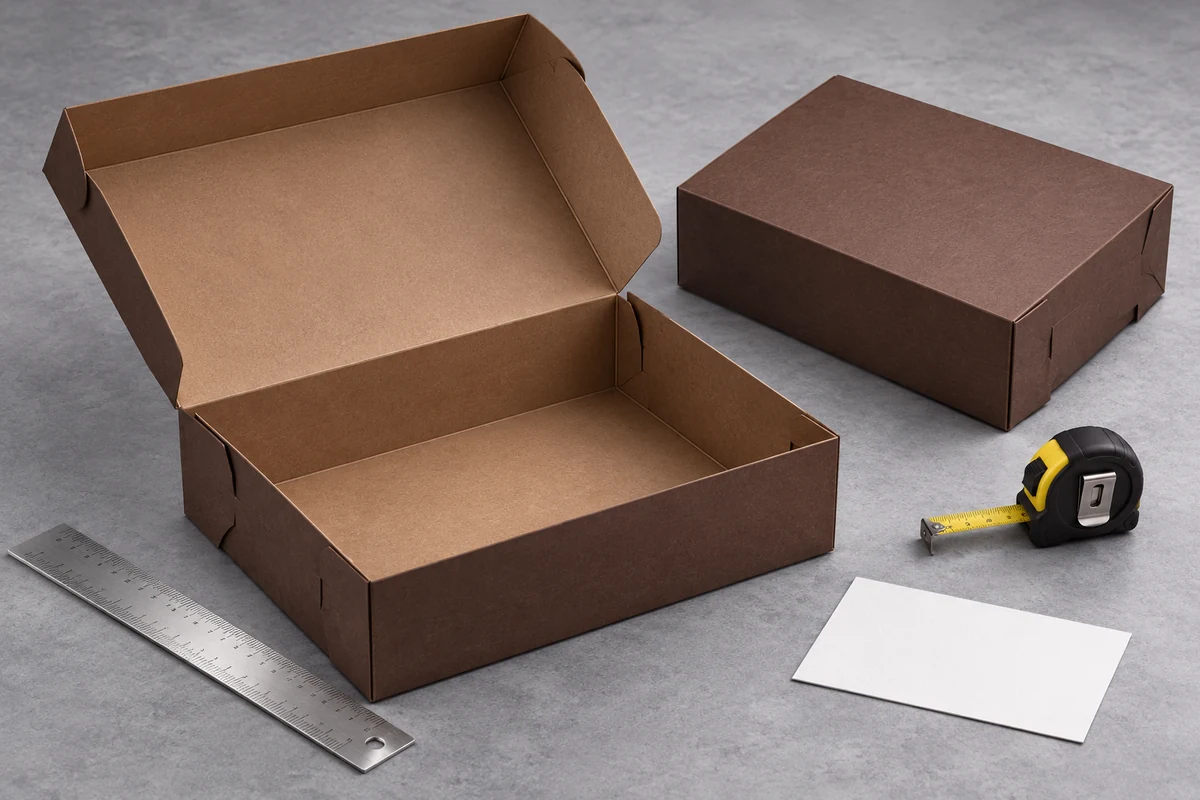
Packaging dimensions are useful only when everyone is measuring the same thing. A product measurement, an assembled box’s outside size, and its usable inside space can produce different numbers.
State what you measured
Send length, width, and height with units, then explain whether they describe your product, a board or tray, or an existing box. Ask the supplier how dimensions are stated for the specific item. Do not assume every product listing uses the same convention.
The outside footprint helps with shelving, bags, and transport space. Usable internal dimensions help determine whether the food and supporting components fit. Folds, closures, and material thickness can affect that usable space.
Measure a complete assembled sample
- Assemble the box in its intended form without forcing the folds.
- Measure the base footprint and available closed height.
- Include the board, insert, liner, and finished decorations in the product measurement.
- Check the opening and closure as well as the space inside.
For a round product, note its widest diameter and finished height. For an assortment, measure the actual layout rather than calculating from one item alone.
Allow for loading and handling
A close numerical match does not guarantee a practical fit. Staff need to load the package without damaging the product, and customers need to remove it. Test the normal carry or delivery process and check for movement or lid contact.
If you are replacing an existing box, send its product code if available and photos showing both the empty structure and the packed order. Mention what works and what you want to improve.
Explore W Packaging’s packaging products and use the quote checklist to organize the remaining details.
Confirm the right size before you order
Discuss packaging dimensions with W Packaging. Include labeled measurements, product photos, quantity, and intended handling so the team can help clarify suitable options.